

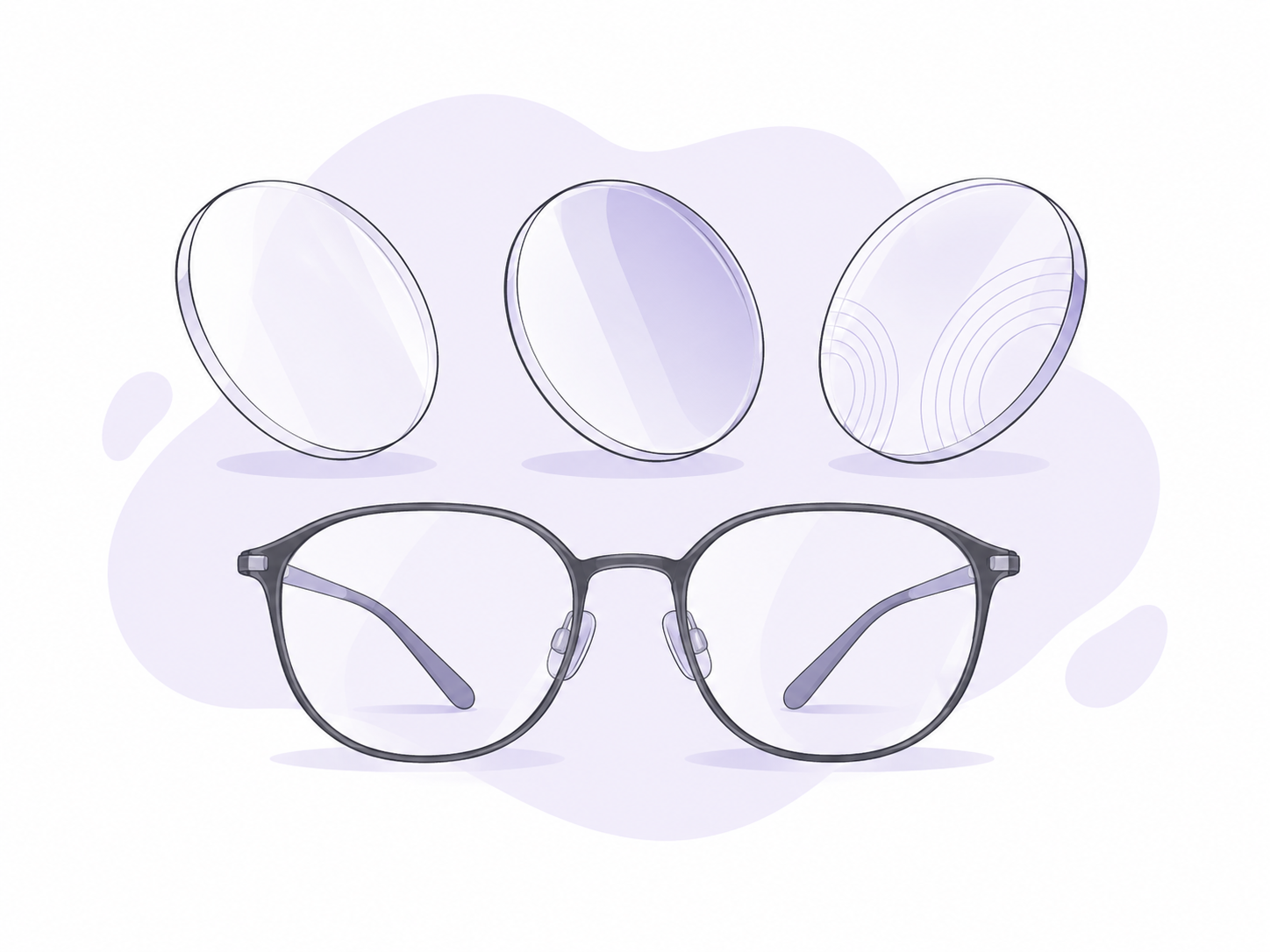
Choosing lenses becomes easier when you separate three decisions: the vision correction you need, the lens material, and the surface treatments. A coating does not change a single-vision lens into a progressive lens, and an attractive tint does not automatically establish UV protection.
Choose the lens design first
| Lens design | Main purpose | Discuss with your optician |
|---|---|---|
| Single vision | One prescribed viewing distance | Whether the prescription is for distance, reading or another working distance |
| Bifocal | Separate distance and near areas | The near segment and its position in the frame |
| Progressive | A gradual transition between viewing distances | Frame suitability, fitting measurements and your everyday tasks |
Use the prescription issued for the task you intend to do. Do not choose a reading correction simply because it looks similar to your distance prescription. If your prescription includes ADD, prism or instructions you do not understand, ask before selecting lenses.
Understand the options without the jargon
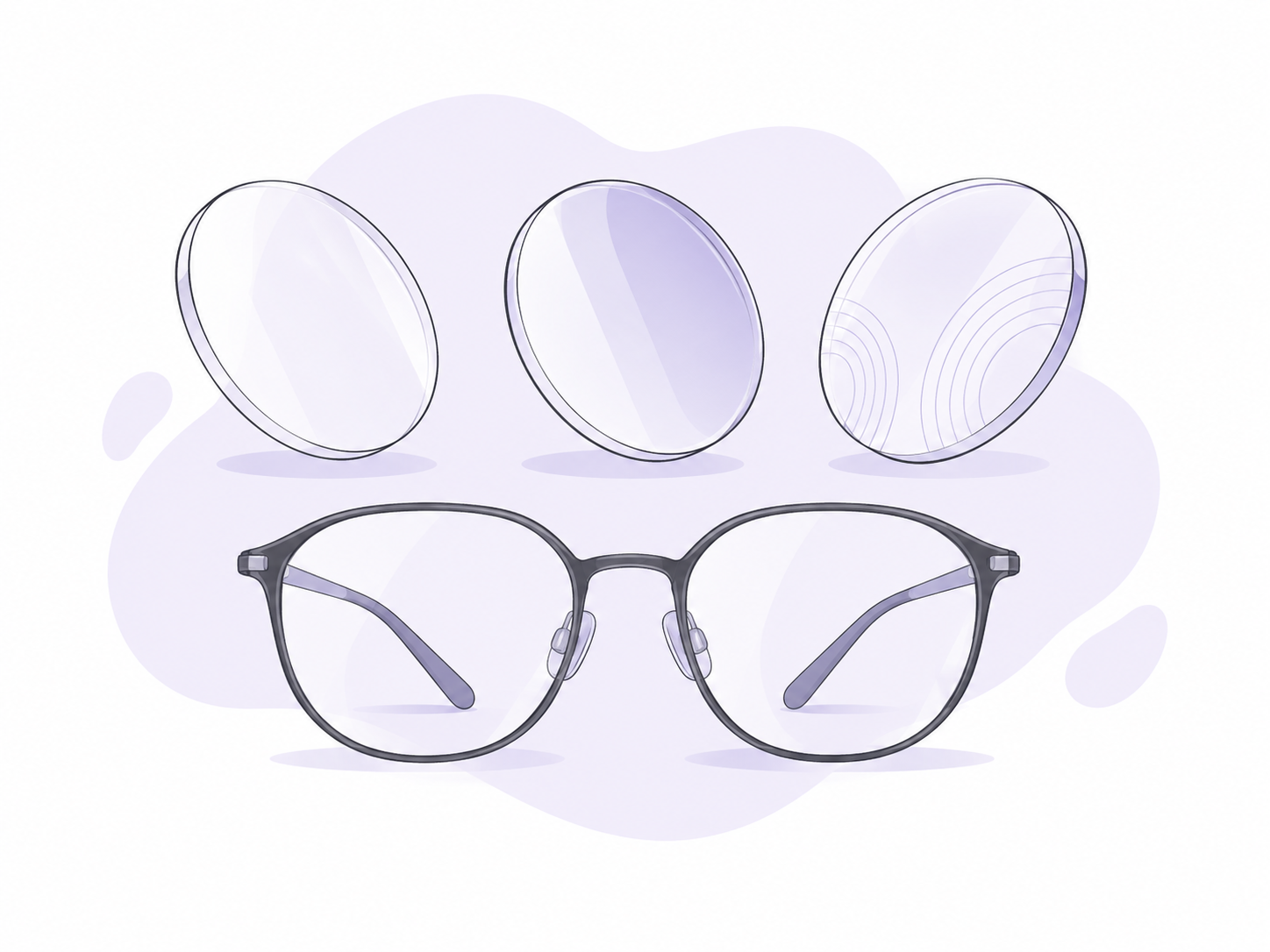
| Option | What it does | Useful question |
|---|---|---|
| Anti-reflective coating | Reduces reflections from the lens surfaces | Which coating is included in this lens package? |
| Scratch-resistant treatment | Helps protect the surface during ordinary use | How should I clean it? Scratch-resistant does not mean scratch-proof. |
| Photochromic lenses | Change tint in response to light conditions | How does this specific product perform inside a vehicle? |
| Polarised sunglasses | Reduce certain reflected glare | Is UV protection also specified, and are they suitable for my activities? |
| Higher-index material | Can offer a thinner lens for some prescriptions | What difference will it make in my particular frame? |
Lens performance varies by material and product. For example, photochromic performance in a vehicle depends on the lens technology and the light reaching it. Ask about the exact option being ordered rather than assuming every adaptive lens behaves identically. See ZEISS guidance on lens options and lens coatings.
Screen use: start with the whole setup
Screen discomfort is not a reason to buy the most expensive coating automatically. Your prescription, working distance, lighting and breaks all deserve attention. Blue-light filtering is not a substitute for an eye examination or a comfortable workstation, and it should not be presented as a guaranteed cure for eye strain. Read the American Academy of Ophthalmology EyeWiki overview of digital eye strain.
A practical shortlist for your order
- Confirm whether your prescription is for distance, near or multiple distances.
- Choose a frame that works with the required lens design.
- Tell the optical team about your main activities: reading, office work, outdoor use or driving.
- Compare the complete lens specification and price, including coatings.
- Check the final order summary before approving the lenses.
Common questions
Are darker lenses always more protective?
Tint darkness alone is not the measure to use. Check the stated UV protection. The American Optometric Association explains UV protection and why appropriate eyewear matters outdoors.
Can I order contact lenses using this guide?
This guide covers spectacle lenses. Contact lenses need a separate prescription and fitting. See the AOA contact lens guidance.
Next, learn how to read your prescription or browse eyeglass frames.